Free · Private · Ready in about a minute
Free Palm Reading Online — read your palm from a photo
Upload one clear photo of your hand. We find your heart, head, life, fate and marriage lines on your palm — not a generic horoscope — and explain what each one means in classic palmistry, in plain words.
How online palm reading works
Three steps, one photo. The better the photo, the more detail we can read — tiny lines like the marriage and sun lines only show up in good light.
Take a clear photo
Open your hand flat, fingers slightly apart. Stand near a window — soft daylight shows fine lines better than a flash.
Upload and pick a hand
Start with your dominant hand (the one you write with). It shows the life you’re living now. Add the other hand to compare.
Read your palm
Get your lines marked on your own photo, a meaning for each one, and links to go deeper on anything that surprises you.
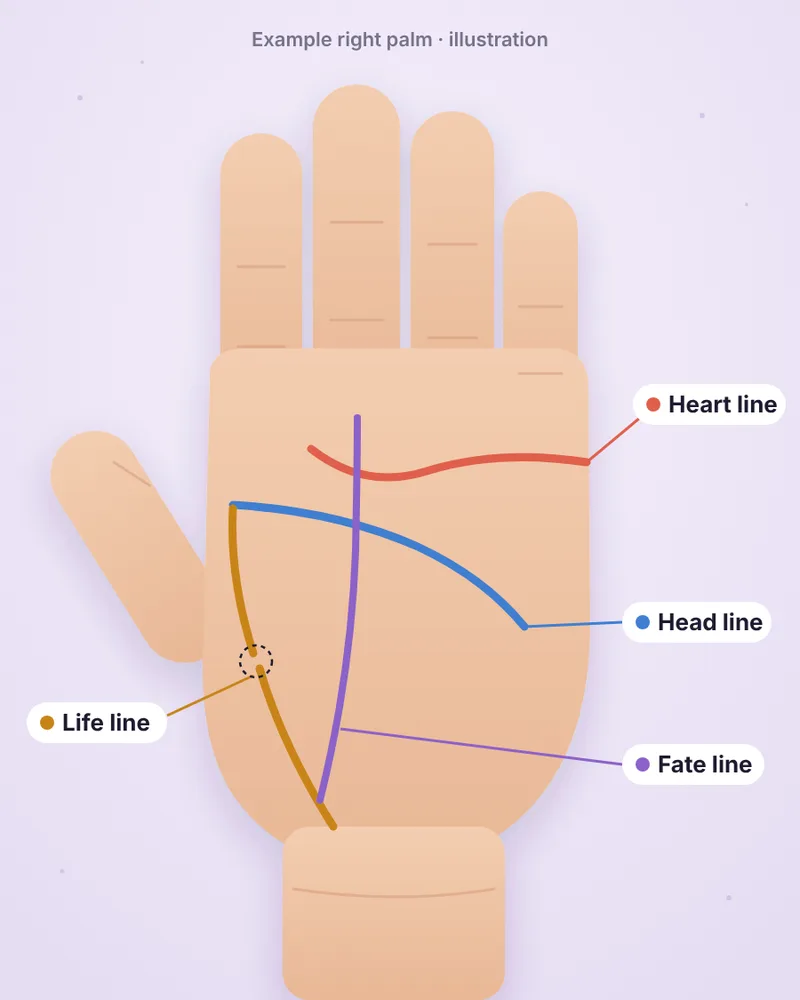
Sample reading
See what a palm reading looks like
This is a shortened version of a real reading. Yours is built from the lines found on your own photo.
What your palm lines reveal
Every hand has three major lines; most have a few minor ones too. Here’s what each is traditionally read for — tap through for photos and every variation.
The basics
Learn palmistry in 5 minutes
Palmistry — also called palm reading, chiromancy or hast samudrika — is the old practice of reading the hand’s lines, shape and mounts to describe personality and life themes. It grew in India, travelled to China and Europe, and each tradition reads a few things differently.
1
Start with the hand, not the lines
Square palm, short fingers: practical (Earth). Square palm, long fingers: curious (Air). Long palm, short fingers: driven (Fire). Long palm, long fingers: sensitive (Water). Hand shapes
2
Find the three major lines
Heart (top), head (middle), life (around the thumb). They’re the deepest creases on almost every hand. Read depth, length and shape before any small marks. All palm lines
3
Then the minor lines
Fate, sun, marriage, health, children and travel lines. Not everyone has all of them, and a missing minor line is common — not a bad sign. Minor lines
4
Read the mounts
The soft pads under each finger and at the base of the palm are named after planets — Jupiter, Saturn, Sun, Mercury, Venus, Moon and Mars. A full mount means that quality is strong. Mounts of the palm
5
Look for special signs last
Stars, crosses, triangles, islands and squares change the meaning of the line or mount they sit on. Context is everything — the same X means different things in different places. Signs on the palm
Worried about a line on your palm?
Four common worries, and the honest answer to each. None of these signs predicts death, illness or divorce.
Popular palmistry questions
Love & marriage
Money & career
Rare signs
For women
What palmistry can — and can’t — tell you
Palmistry is a tradition, not a science. It’s a thoughtful way to reflect on your temperament, relationships and choices — and it’s been doing that for over two thousand years. It can’t diagnose illness, predict a death, or tell you when a divorce will happen. Any site that says otherwise is selling fear.
So we write every guide the same way: a clear answer first, real hand photos, how Western, Indian and Chinese palmists differ, and the myths spelled out.
It can
Describe personality, love style and how you think
It can’t
Predict how long you’ll live
It can
Prompt honest reflection on choices and timing
It can’t
Replace a doctor, lawyer or financial adviser
Palm reading FAQ
Ready to read your palm?
One photo, about a minute, and every line on your hand explained — free.