Can Palmistry Show Your Marriage Age?
By Clara Wynn · Last reviewed: October 2026
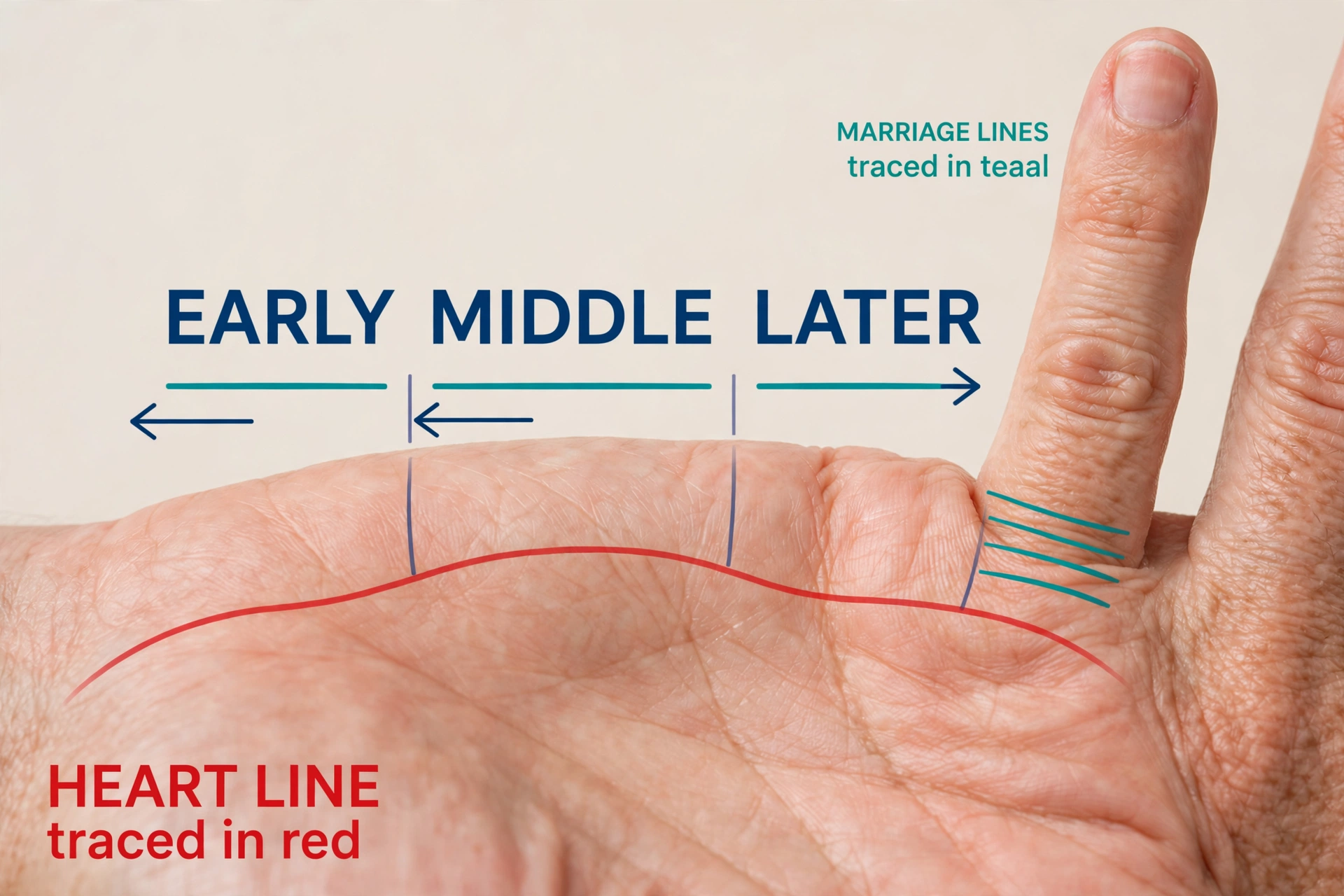
Palmistry has a traditional method for estimating marriage timing: the closer a marriage line sits to the heart line, the earlier the bond; the closer to the little finger, the later. But it’s one of the least reliable parts of palmistry, and no palm line can tell you an actual date or age. Use it for fun, not for planning.
How the traditional method works
Look at the outer edge of your palm, between the heart line and the crease at the base of your little finger. Palmists treat that space as a rough timeline.
| Where the marriage line sits | Traditional reading |
|---|---|
| Close to the heart line (lower third) | An earlier significant bond, often read as late teens to early 20s |
| In the middle | A bond in the mid-to-late 20s |
| Close to the little finger (upper third) | A later significant bond, often read as the 30s or later |
Different palmists and traditions divide this space differently, so you’ll find different age ranges online. That alone tells you how rough the method is.
Want a reading of your own relationship lines? Scan your palm for free and see what your heart and marriage lines say.
How to try it on your own hand
- Use your dominant hand in daylight, little finger straight.
- Find the heart line and the crease at the base of your little finger.
- Divide the space between them into three equal parts.
- See which part your deepest marriage line sits in.
- Remember that the line is read as a significant bond, which may or may not be a marriage.
Why it isn’t reliable
- The lines are tiny, and a millimeter’s difference moves the “age” by years.
- Traditions disagree on how to divide the space.
- Marriage lines aren’t marriages. They’re read as important bonds, which can be a long relationship, a first love or a marriage.
- Life choices change timing. Palmists themselves say lines describe tendencies, not dates.
So treat any age you read as a playful guess, not a prediction.
Other timing methods you’ll see online
- Life line timing: some palmists divide the life line into ages and look for branches toward the heart line or marriage zone.
- Fate line timing: a line joining the fate line is sometimes read as a partner entering your life at that point.
- Indian palmistry: some readers combine palm lines with a birth chart for timing.
All of these share the same problem: they’re symbolic and can’t be checked.
Western vs. Indian vs. Chinese readings
| Western | Indian (Samudrika Shastra) | Chinese | |
|---|---|---|---|
| Timing method | Position between heart line and little finger | Same area, sometimes combined with astrology | Marriage line position and fate line |
| How firmly it’s used | Loosely, as a rough guide | More often given specific ages | Varies |
Myth vs. fact
| Myth | Fact |
|---|---|
| Your palm shows your exact wedding age. | Timing methods are rough and unreliable. |
| A line near the heart line means you’ll marry very young. | It’s read as an earlier significant bond, which may not be a marriage. |
| No marriage line means you’ll never marry. | It’s read as a private approach to love, not a prediction. |
| A late marriage line means you’ll be lonely until then. | It’s read as the timing of a significant bond, not a lonely life before it. |
See your relationship lines.
Upload a photo to our free palm scanner for a reading of your heart and marriage lines.


