Palm Reading Lines: Complete Guide with Pictures
By Clara Wynn · Last reviewed: October 2026
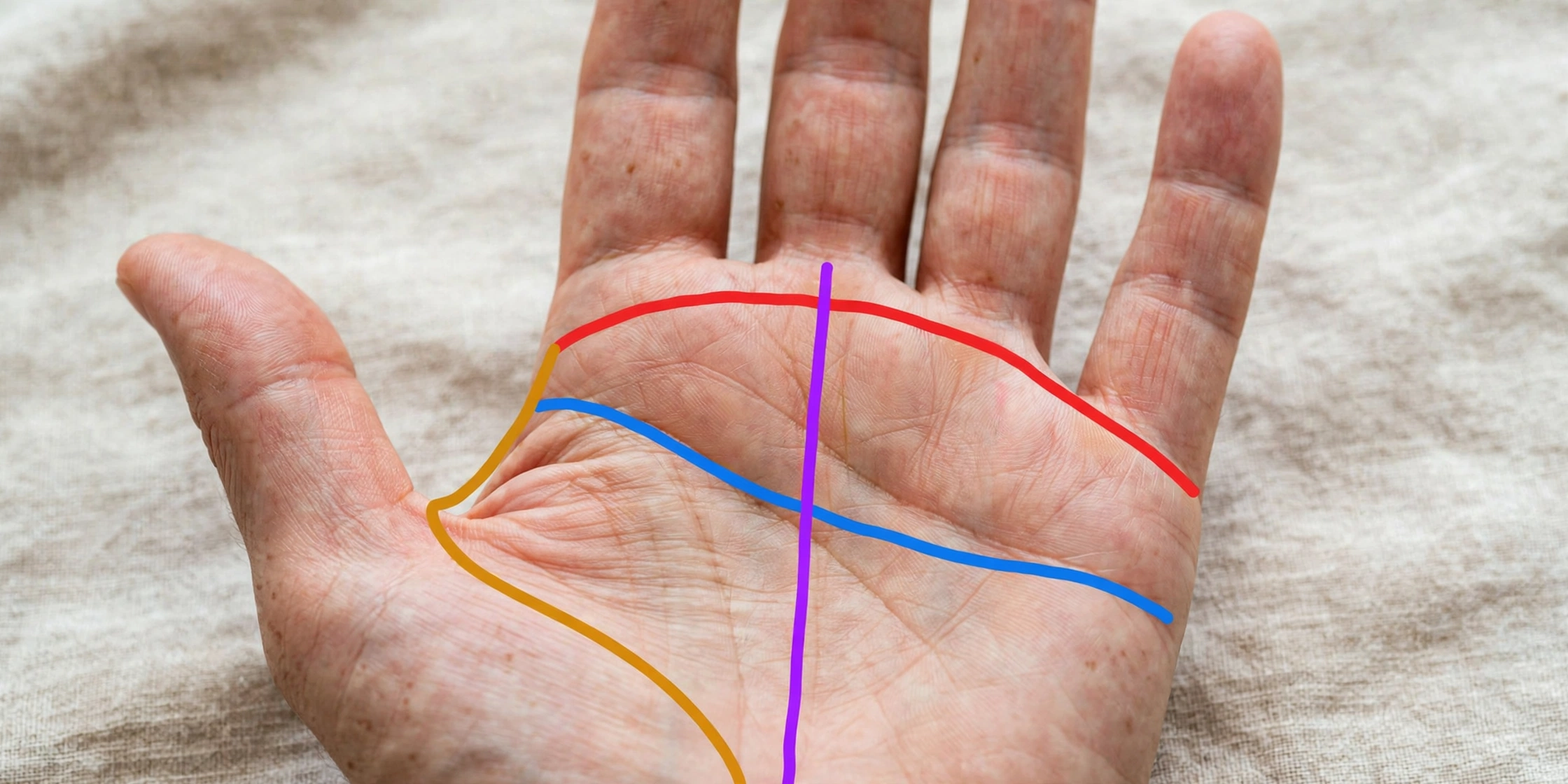
Palm lines are the creases on your hand that palmists read to describe personality and life themes. Almost every hand has three major lines: the heart line (emotions), the head line (thinking) and the life line (energy). Most people also have a few minor lines, like the fate, sun and marriage lines. None of them predicts when you’ll die.
This palm lines guide shows you where each line sits, what palmists traditionally read in it, and where the Western, Indian and Chinese traditions disagree. Each line also has its own detailed guide if you want to go deeper.
The palm lines at a glance
| Line | Where it is | Traditionally read for | Does everyone have it? |
|---|---|---|---|
| Heart line | Top horizontal crease, below the fingers | Love, emotions, how you connect | Almost everyone |
| Head line | Middle horizontal crease | Thinking style, decisions | Almost everyone |
| Life line | Curve around the base of the thumb | Energy, resilience, big life changes | Almost everyone |
| Fate line | Vertical line up the middle toward the middle finger | Career, direction, outside influences | No, often missing |
| Sun line | Vertical line toward the ring finger | Recognition, creativity, satisfaction | No, often missing |
| Marriage lines | Short marks on the edge below the little finger | Close bonds and commitments | Most people |
| Health line (Mercury line) | Diagonal line toward the little finger | Traditionally health and nerves | No, often missing |
| Children, travel and other minor lines | Small lines in specific zones | Specific life areas | Varies a lot |
If your heart and head lines look like one single line running across your palm, you may have a simian line. It’s an anatomical variation found in about 1 in 30 people, according to MedlinePlus, and palmists read it in its own way.
How to find your palm lines
You don’t need any special tools, just good light and a minute.
- Pick your dominant hand (the one you write with). In modern palmistry it shows the life you’re living now.
- Stand near a window. Soft daylight shows fine lines much better than a ceiling light or a flash. Cup your hand very slightly and the creases deepen.
- Find the heart line first. It’s the highest horizontal crease, running from the edge of your palm below the little finger toward your index or middle finger.
- Drop down to the head line. It runs across the middle of your palm, usually starting near the thumb side, often touching the life line at its start.
- Trace the life line. It begins between your thumb and index finger and curves around the fleshy base of your thumb toward the wrist.
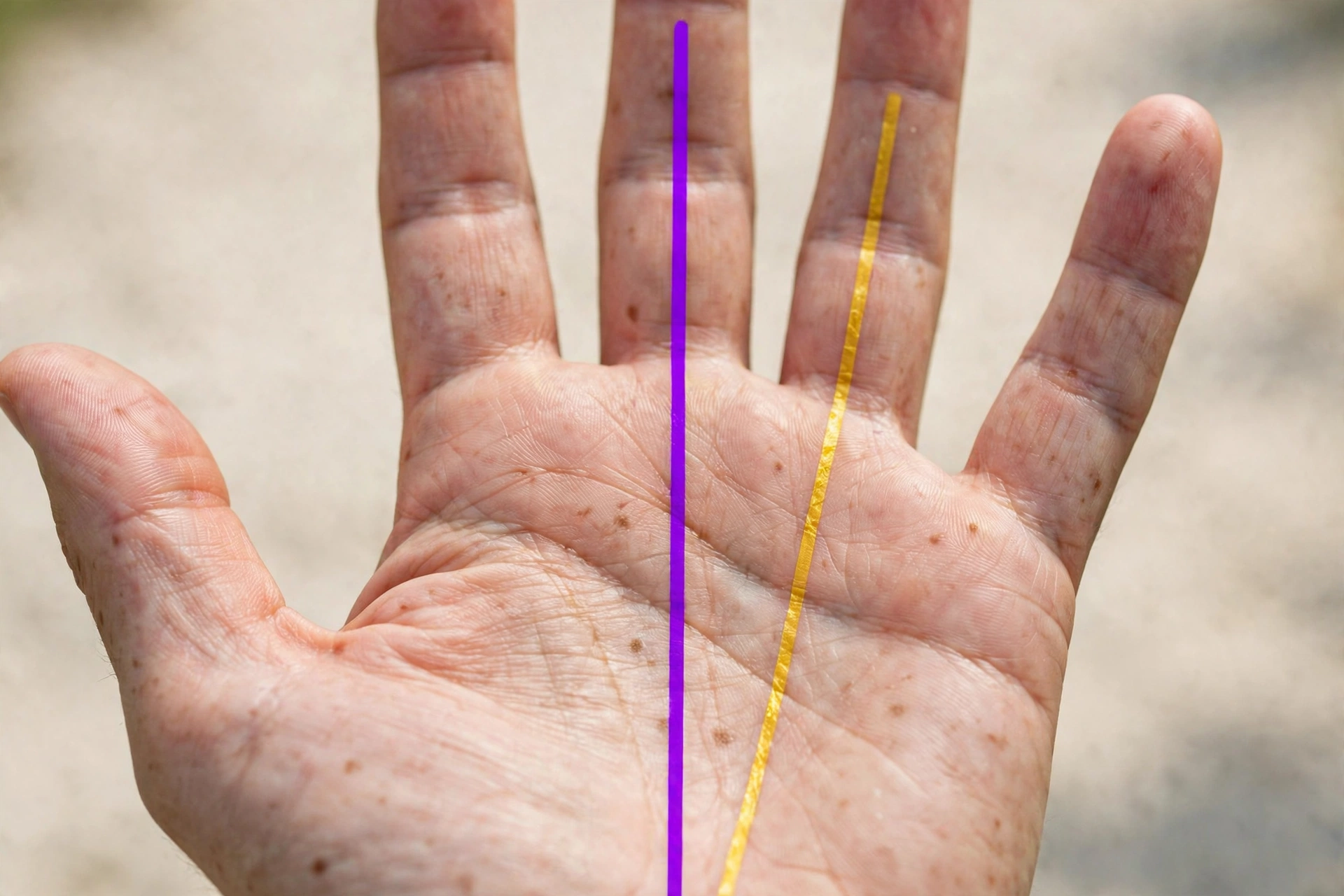
- Look for vertical lines. A line running up the center toward your middle finger is the fate line. One heading toward your ring finger is the sun line. Don’t worry if you can’t find them; many people don’t have them.
- Check the edge of your palm below the little finger. The short horizontal marks there are the marriage (relationship) lines.
Lines people often mix up:
- Heart vs. head line: the heart line is always the upper one. If you only see one line crossing the palm, that’s likely a simian line.
- Fate vs. sun line: follow them up. The fate line aims at the middle finger; the sun line at the ring finger.
- Life line vs. a “sister line”: some people have a second, thinner line running inside the life line. Palmists read it as extra support, not a second life line.
Not sure which line is which on your own hand? Scan your palm with our free palm reader and get a reading of your major lines in a couple of minutes.
The three major lines
These are the deepest creases on almost every hand, so palmists read them first. Look at three things on each: length, depth (deep and clear, or faint) and shape (straight, curved, broken, forked).
Heart line: emotions and relationships
The heart line describes how you love, how you show feelings and how you recover from hurt.
- Curving up toward the index or middle finger: traditionally read as warm and open; you show affection easily.
- Straight and fairly short: read as private and careful; you feel deeply but show it less.
- Ending between the index and middle fingers: often read as a balance of heart and head in relationships.
- Deep and clear: steady emotions. Chained or wavy: a sensitive nature with emotional ups and downs.
Read the full heart line guide, with every variation.
Head line: how you think
The head line is about your thinking style, not how smart you are.
- Straight across the palm: practical, logical, likes facts.
- Sloping down toward the base of the palm: imaginative and creative; you think in pictures and possibilities.
- Starting joined to the life line: traditionally read as cautious, with close ties to family early on. Starting separate: independent from an early age.
- Long vs. short: a long line suggests someone who weighs things carefully; a short one, someone who decides quickly.
Read the full head line guide.
Life line: energy, not lifespan
The life line is the most misunderstood line in palmistry. It does not show how long you’ll live. Palmists across traditions read it for energy, stamina and major turning points.
- Wide curve sweeping into the palm: lots of energy, enthusiasm, a love of activity.
- Tight curve close to the thumb: a quieter, more cautious use of energy.
- Deep and clear: steady vitality. Faint: traditionally read as needing more rest and balance.
- A break: read as a major change, like a move, a new job or a fresh start. It’s not a warning. Here’s what a broken life line really means.
What does science say? Researchers have tested the old belief on measured hands three times. A 1974 study found no link between life line length and age at death; a small 1990 study of 100 bodies reported one; and a 2019 study of 60 bodies found no significant correlation. Taken together, there’s no reliable evidence that a short life line means a short life.
Read the full life line guide.
The minor lines
Missing one isn’t a bad sign. Palmists simply read its absence differently.
Fate line (destiny or Saturn line)
The fate line runs up the middle of the palm toward the middle finger. It’s read for career, sense of direction and how much outside forces shape your path.
- Starting at the wrist: a sense of direction from early on.
- Starting from the life line: a self-made path, often with family support.
- Starting mid-palm: direction found later, through experience.
- No fate line at all: common, and traditionally read as a self-directed life rather than a fixed track. More on having no fate line.
See the full fate line guide, or how palmists link it to your career.
Sun line (Apollo line)
A vertical line rising toward the ring finger. It’s traditionally read for recognition, creativity and how satisfied you feel with your achievements. A clear sun line is a classic sign of public success; a faint or missing one usually means success comes through quieter routes. Read the sun line guide.
Marriage lines (relationship lines)
The short horizontal marks on the edge of your palm, between the heart line and the little finger. Modern palmists read them as significant emotional bonds and commitments. They don’t count marriages or predict a wedding date or a divorce. Read the honest marriage line guide.
Health line (Mercury line)
A line running diagonally toward the little finger. Traditional palmistry links it to health and digestion; Merriam-Webster lists “line of Health” and “Hepatica” as its old names. Modern palmists read it loosely as nervous energy and stress, and it can’t diagnose anything. If you have a health concern, see a doctor, not a palm reader.
Children, travel and other small lines
Thin vertical lines above the marriage lines are traditionally called children lines, and short lines on the outer edge of the palm are called travel lines. These are the most symbolic parts of palmistry, so treat them as fun, not facts. They’re covered in our guides to minor palm lines and children lines.
How to read a line’s quality
The same line can be read differently depending on how it looks. These features apply to any line:
| What you see | What it looks like | Traditionally read as |
|---|---|---|
| Deep and clear | A strong, even crease | Steady energy in that area of life |
| Faint or thin | Hard to see without good light | Flexibility, or energy you haven’t fully used yet |
| Broken | A clear gap in the line | A change or turning point, not a disaster |
| Overlapping break | The line stops and restarts alongside itself | A change with support carried through it |
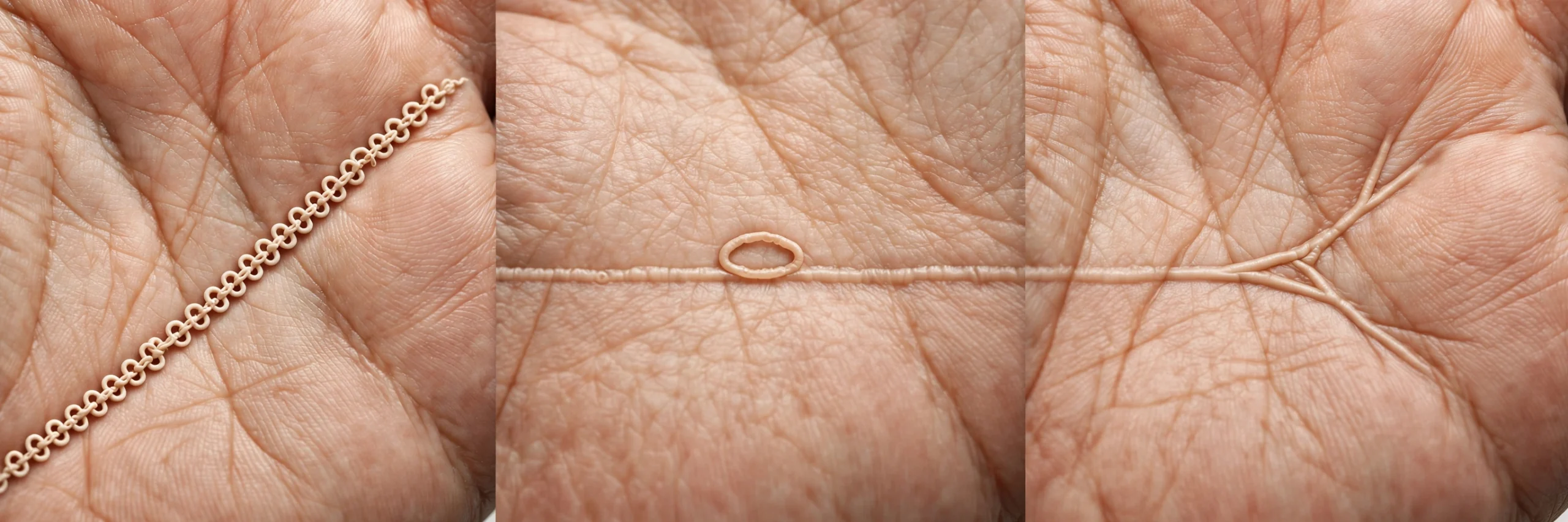
| Chained | Tiny loops like links of a chain | Ups and downs, sensitivity |
| Island | A small oval loop in the line | A period of stress or low energy |
| Forked end | The line splits in two at the end | Balance, or two strong interests |
| Wavy | An uneven, wandering path | Changeable focus or moods |
| Doubled (sister line) | A thin second line running alongside | Extra support or resilience |
Western, Indian and Chinese palmistry compared
All three traditions read the same three major lines. They differ in emphasis and in which hand comes first.
| Western palmistry | Indian palmistry (Samudrika Shastra) | Chinese palmistry | |
|---|---|---|---|
| Main focus | Shape, depth and clarity of each line, plus hand shape and mounts | Lines plus special signs and symbols, line color and how many lines there are | Lines read together with hand shape and the five elements |
| Line names | Heart, head, life, fate | Hriday rekha (heart), mastishk rekha (head), jeevan rekha (life), bhagya rekha (fate) | Similar lines, often with their own traditional names |
| Main hand | Dominant hand (modern rule) | Traditionally right for men, left for women | Traditionally left for men, right for women |
| Known for | Cheiro and William Benham’s classic books | Rich detail on signs like the fish, trident and star | Rules that change with age and gender |
In practice, most palmists today combine these approaches. Our guides lead with the Western reading and point out where Indian or Chinese palmistry differs.
Left hand, right hand, men and women
The modern rule is simple: read your dominant hand for your current life and choices, and your other hand for inborn traits and potential. It’s the same for men and women. A left-handed person just reverses it. This palm lines guide follows that modern rule throughout.
The older gender rules (right for men and left for women in Indian tradition, the reverse in Chinese tradition) still show up online, which is why advice often contradicts itself. The lines themselves mean the same thing on any hand. Our which hand to read guide lays the rules out side by side, and there’s a separate guide on palm reading for women.
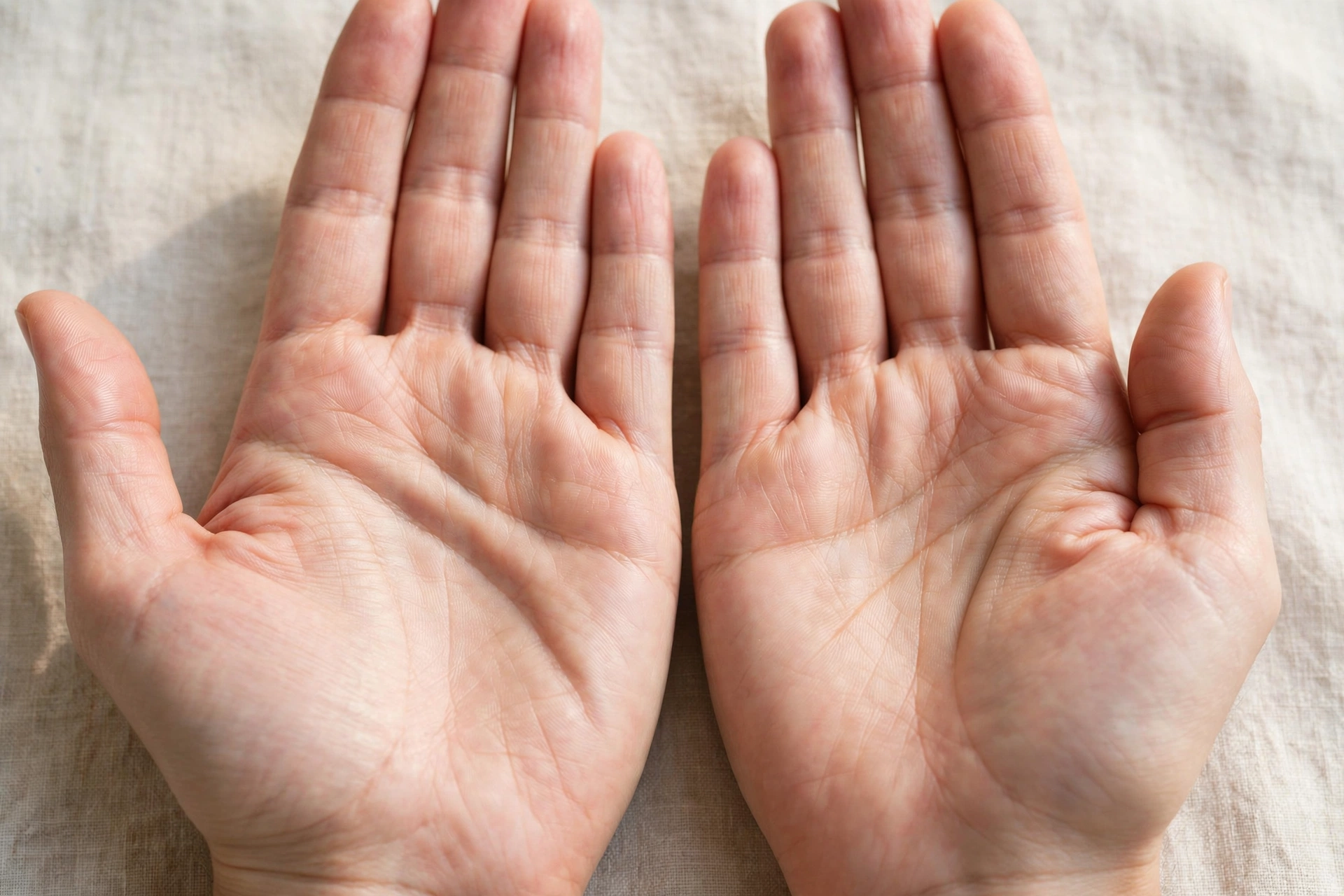
If a line looks very different on your two hands, palmists read that as a trait you’ve developed or changed over your life, rather than one you were born with.
Combinations worth knowing
Palmists rarely read one line on its own. A few combinations come up often:
- Simian line + strong fate line: intense focus channeled into work or a clear goal.
- Broken life line + sister line beside the break: a big change, with support carrying you through it.
- No fate line + strong, clear head line: a self-directed path, steered by careful thinking.
- Letter M on the palm: formed when the heart, head, life and fate lines join in an M shape. What the M on your palm means.
- An X between the heart and head lines: traditionally called the mystic cross. Its meaning depends on exactly where it sits. See the X sign guide and our overview of rare signs on the palm.
Myth vs. fact
| Myth | Fact |
|---|---|
| A short life line means a short life. | The life line is read for energy, not lifespan, and studies on measured hands haven’t found a reliable link. |
| A broken line is a warning of an accident or death. | A break is read as a change of direction or a new chapter. |
| Marriage lines show how many times you’ll marry. | They’re read as meaningful bonds, not a count of weddings. |
| No fate line means no future or no success. | Many people have no fate line; it’s read as a self-directed path. |
| Palm lines are fixed for life. | The major creases stay largely the same, but fainter minor lines can become more or less visible over the years. |
Do palm lines change over time?
Partly. The main creases form before you’re born and stay much the same through adult life. Smaller lines can deepen, fade or become easier to see as your skin and hands change with age. That’s why many palmists suggest photographing your palm every few years and comparing.
Palmistry is a tradition, not a science. It’s a thoughtful way to reflect on your temperament and choices, but it can’t diagnose illness or predict events.
See what your own palm lines say.
Upload one photo to our free palm scanner and get a reading of your heart, head, life and fate lines on your own hand.


